

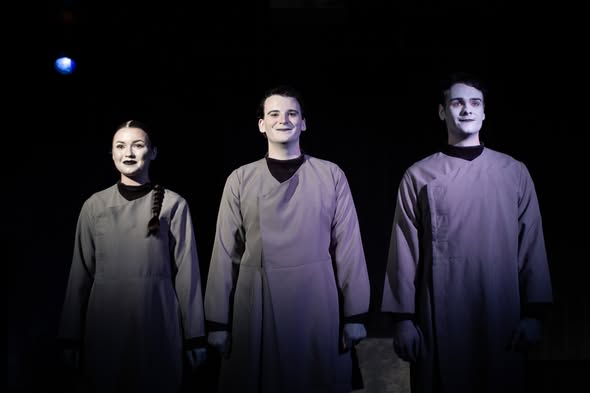
Theatre Department’s The Giver asks hard questions of its audience
The theatre department’s first play of the semester traded spotlights for graywash as it brought Lois Lowry’s “The Giver” to life.
The show ran from Sept. 11-13 in Sewell’s Black Box Theater. Unlike other theaters, the venue does not feature a lifted stage.
Instead, actors with pale-powdered faces and dyed dark hair stood an arm’s reach away from the audience as they told the story of Jonas, Sameness and a world without choice.
The play followed the main character, Jonas, as he’s assigned the role of Receiver of Memory in a world called the Sameness. In the Sameness, people have chosen to forget the past, in exchange for a painless present.
While his friends and family continue to live as society expects, Jonas begins to question the world around him.
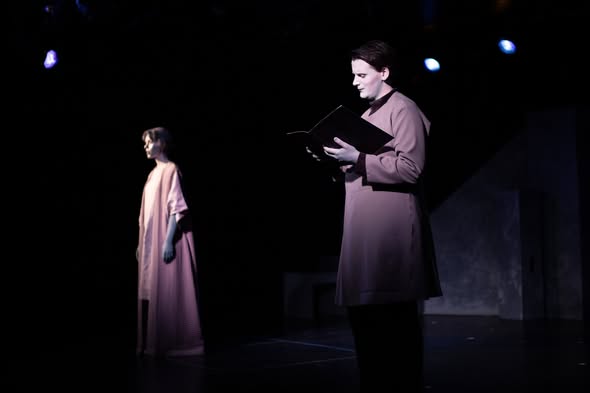
The hard questions Jonas asks himself are at the heart of director Sarah Cooper’s vision of “The Giver.”
Cooper, a senior Law Justice and Society and Theatre double major, chose Lowry’s beloved 1993 children’s novel as her directorial debut for a simple reason.
“I really wanted to do a story that’s based on a book that people love,” she said. “I love bringing things to life that I liked reading on a page.”
Cooper’s bold creative calls ensured the audience was immersed in the story.
The actors powdered their faces white and wore black lipstick. These choices, alongside the similarly shaded tunics of gray and monotone backdrop, made the world appear truly colorless.
Other decisions made by Cooper included the cast moving the pieces of the set around the stage in sudden bursts. “Each scene is flitting from moment to moment,” said Cooper. “My goal was to catch the audience a little bit off guard as we got into each new place, because Jonas is off guard. Because he cannot keep up with the world that’s moving around him.”
Droning sounds replaced music in the production. In moments shared between Jonas and his parents, Cooper traded the warmth of a dinner table for family discussions that sounded most like pseudo therapy sessions.
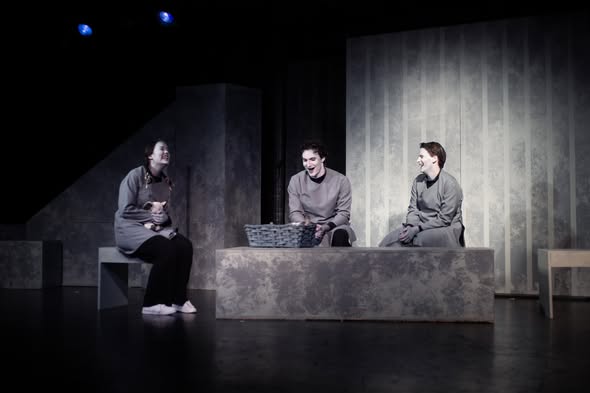
Together, the intimate feel of the theater, physical similarities in the actors and the dullness of the set served Cooper’s greater purpose for the play. In Cooper’s “The Giver,” the Sameness is a mirror of modern society, rather than a portrayal of a distant future.
“It’s much more about what human beings’ decisions and ethics,” said Cooper. “Would you give up the chance to remember your life or remember the people you love or give up love entirely if that means there was no pain in your world?”
Ultimately, Jonas decides he’s not willing to pay this cost as he escapes the Sameness.
“At the end of the day, I think that when we keep… choosing to give up things for this so called better life, we have to know what we’re giving up,” said Cooper.
This perspective of “The Giver” becomes all the more relevant in an era of increased surveillance. Throughout the play, characters’ private actions are commented on by the government via an intercom. Recordings of, seemingly, each passing moment can be accessed by influential figures, such as Receivers of Memory.
Scenes like these are what makes Cooper’s take on “The Giver” feel less like a children’s tale and more like a modern social commentary. Jonas’ Sameness looks more like the contemporary America of Flock cameras and constant social media purveying than it does an alternative universe.
This fact was not lost on Cooper throughout the development of the play.
“With dystopian stories, it can feel very far away for us,” said Cooper. “It can seem like that’s far in the future. But Lois Lowry intends for this story to be very soon.”
If a society resembling the Sameness is approaching soon, then the decisions that lead to it are happening now. “The Giver” predicts that the choices Americans make today about what they are willing to give up for a potentially smarter and safer society will shape the country for generations to come.
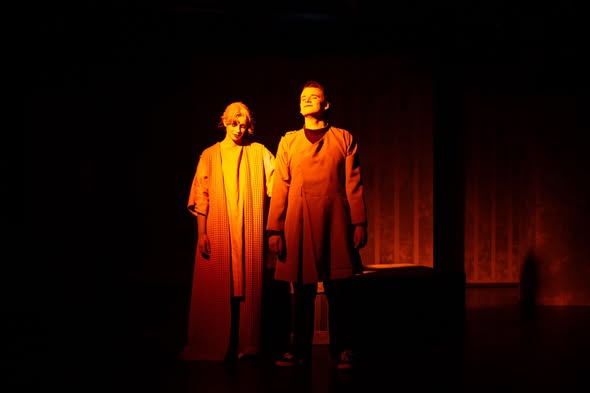
Neither Cooper nor Lowry make the claim that the “The Giver” is a prophetic take on the direction of the country. However, its message is clear.
“When you are passive in what happens in your life, and you let everything continue around you, it brings you closer and closer into a society where you are not given choices,” said Cooper.
The play, then, gives the audience a challenge. Just as Jonas questioned the world around him, Cooper believes “The Giver” asks its audience to pause and examine their society.
“What is happening now that can bring me into this future?”
Sarah Cooper interview conducted by Arlie Akers
Feature image courtesy of Lipscomb Theatre Department.