
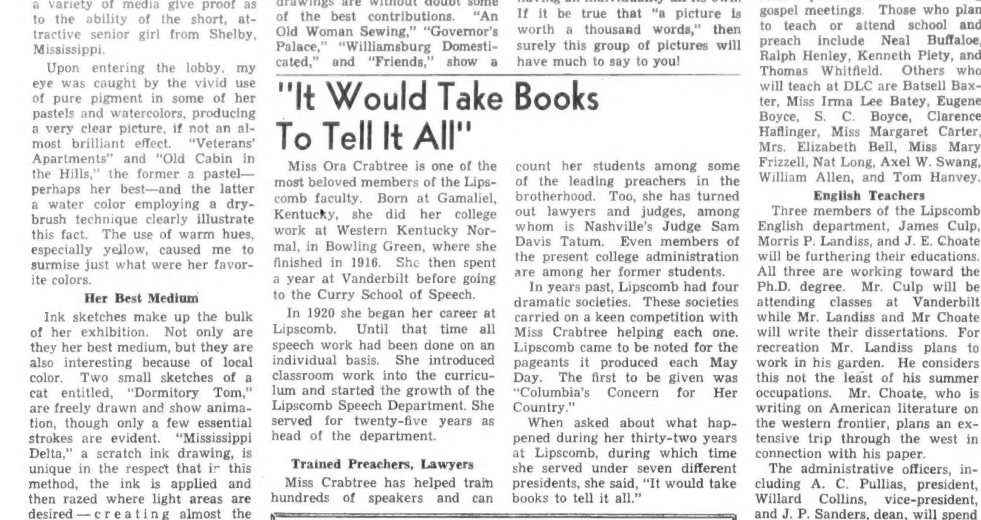
It would take books to tell it all: 1952 Lipscomb through the eyes of the university’s oldest living editor
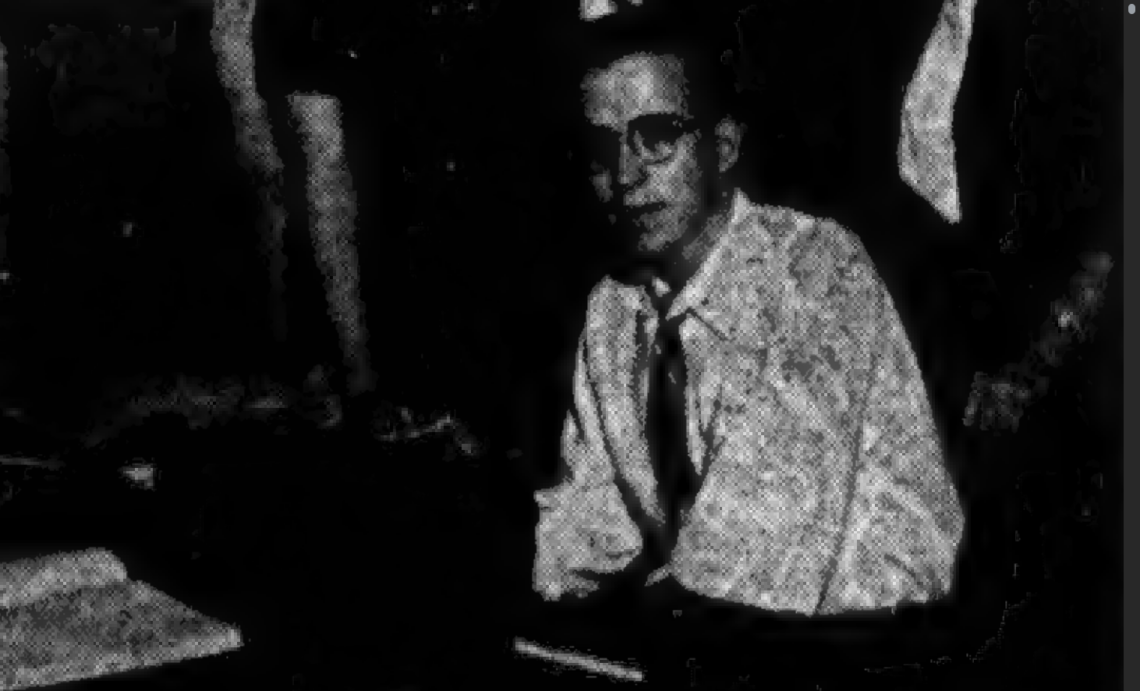
On Thursday afternoons in 1952, Wayne Estes rode the bus from David Lipscomb College to McQuiddy Printing Company in downtown Nashville. He would stay late into the evenings, and often into the night, trimming the stories and rewording the headlines for the next edition of the Babbler.
He called this process “putting the paper to bed.” Estes served as the Editor-in-Chief of the Babbler from September of 1951 to May of 1952. Printing the paper was one of Estes’ chief responsibilities. He printed 27 weekly editions of the paper during that nine-month period.
By the time Estes returned to David Lipscomb, the cafeteria had closed for the night, and he missed his afternoon French class. He would wake up the next morning to the papers delivered to the campus.
Seventy-four years later, Estes looks back on the process as worthwhile. “It was very distinguished,” said Estes. “Very hard work, but it seemed to go well.”
Estes had served in this role before at Milan High School’s paper, the Bulldog Chatter. In his small West Tennessee hometown, Estes developed a love for journalism. “It grew out of an almost boundless curiosity about all kinds of things,” wrote Estes in his 1999 memoir.
Upon graduating high school, Estes came to David Lipscomb College as an English major. His school experience was otherwise normal: he lived in the all-boys dorm Elam Hall and participated in the press club and the Student Guidance Service. Becoming Editor-in-Chief in his junior year, however, allowed him to see the college through a broader perspective.
Estes and a team of five other students served as the editorial staff for the Babbler’s 31st edition. They worked in the basement of the library. The paper covered topics relevant to the student body at the time, ranging from the Korean War to the most recent theater productions. “We did not seek sensational things for the paper, but we tried to have good news stories,” said Estes.
Estes’ work provides a glimpse into the conversations that were important to Lipscomb students in 1952.
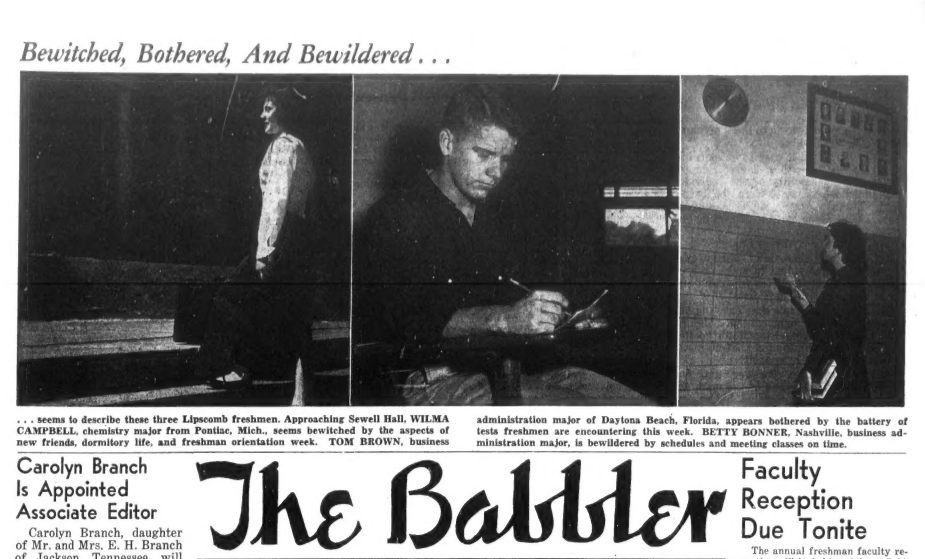
Estes recalls not receiving much pushback on the work he and his colleagues printed. “We tried to avoid controversy. We didn’t live for controversy,” said Estes. The most controversial topic Estes recalls was the new men’s basketball coach. The debate on social clubs also arose as a heated conversation on campus.
At the time, Lipscomb did not have social clubs. The question of introducing them to campus became highly contested. “Last week you asked the question, ‘Should Lipscomb have Social Clubs?’” wrote one student, called D.G., in the Dear Editor column of the January 1952 edition. “My answer is an emphatic no! It is of a vital interest to all of us and the future students of Lipscomb…”
This same Dear Editor column proved to be one of Estes’ favorite portions of the paper. “The BABBLER invites letters from students, alumni, or friends,” is written in bold in the November edition. This column allowed for a wide range of opinions to reach students via the paper. Alumni and professors often submitted their letters for inclusion.
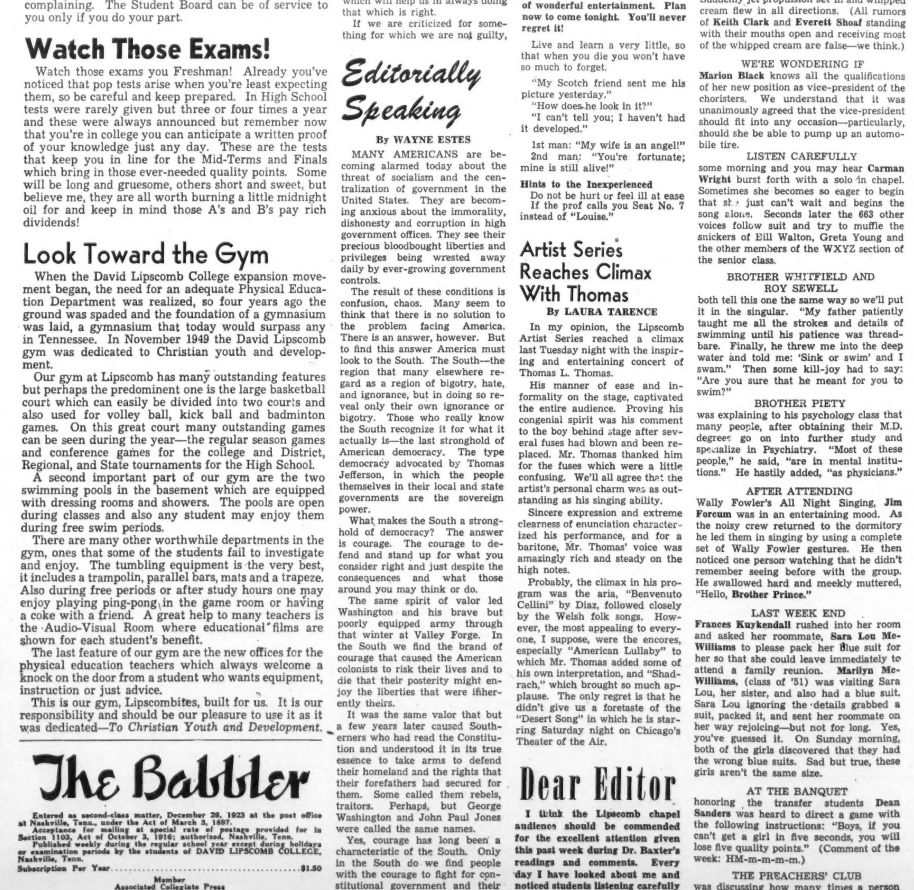
Another unique column found in the 1951-52 Babbler is Estes’ “Editorially Speaking.” Estes used this column to speak directly to students. The second edition of this column saw Estes arguing against the rise of socialism and for the empowerment of the South.
“Those who really know the South recognize it for what it actually is—the last stronghold of American democracy,” wrote Estes in October of 1951. In the column, he praised the courage that inspired Southerners “to take arms to defend their homeland and the rights that their forefathers had secured for them.”
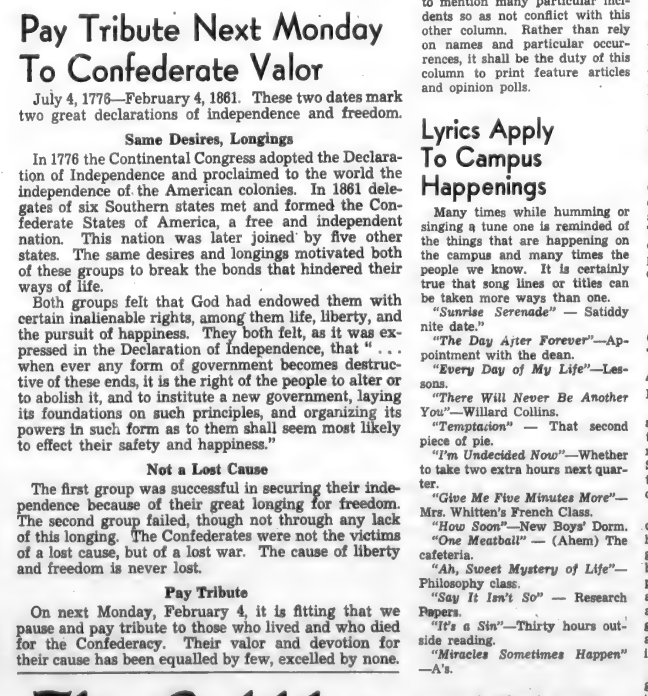
The February edition in 1952 would promote a Confederate memorial, saying “Confederates were not the victims of a lost cause, but of a lost war. The cause of liberty and freedom is never lost.”
Articles such as these penned by Estes reflected the tension in the South and on Lipscomb’s campus in 1952. Lipscomb would not desegregate until 1965, 12 years after Estes graduated.
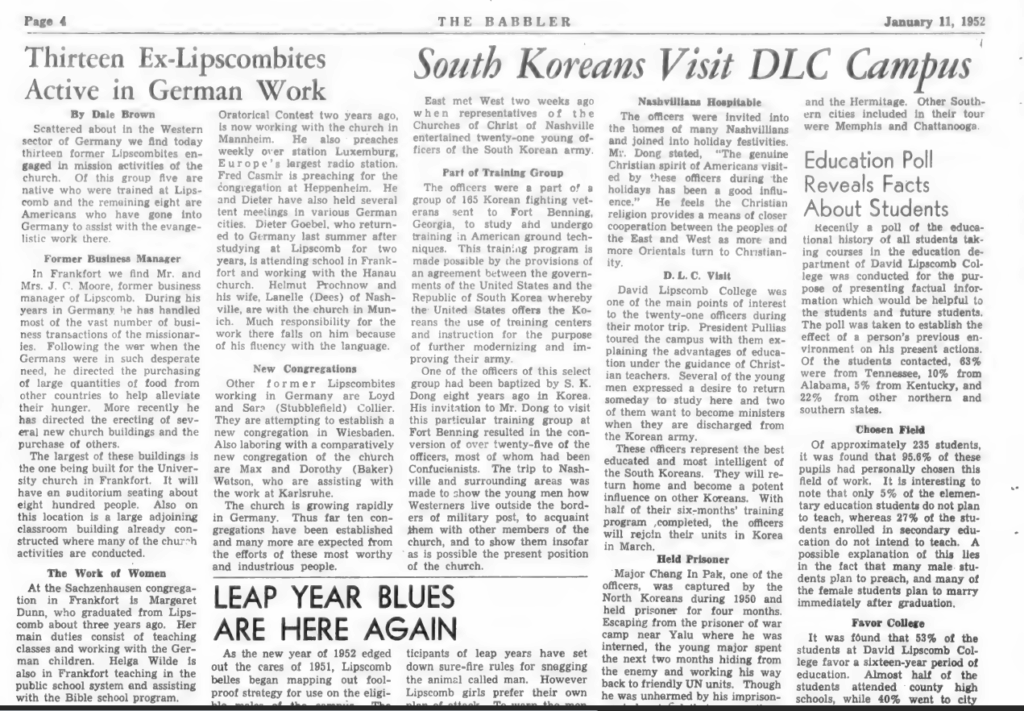
Other tensions also affected campus, such as conversations around the Korean War.
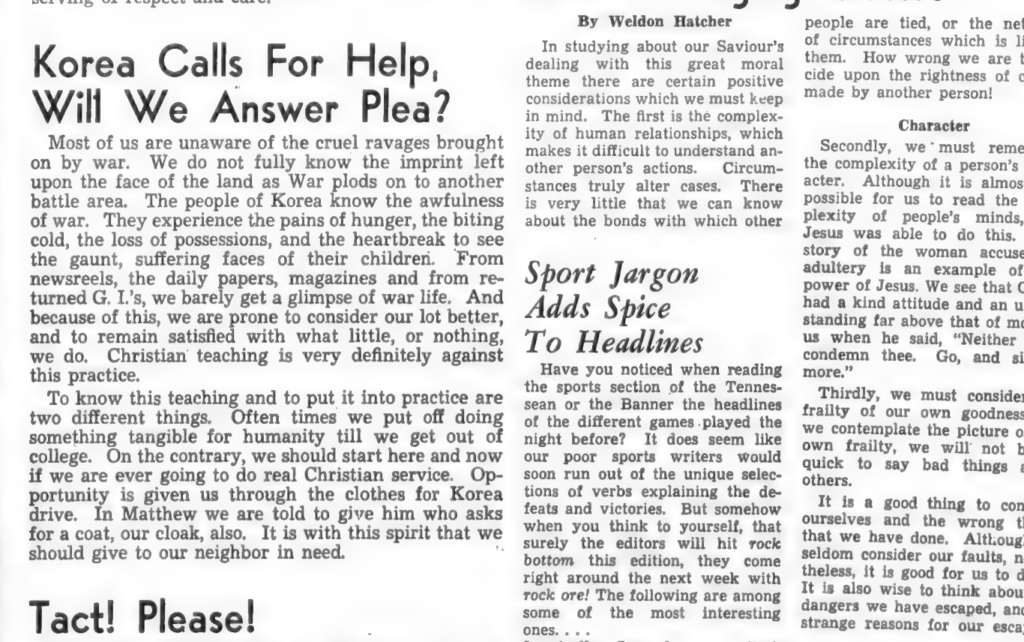
Throughout the 31st edition of the Babbler, Korea is mentioned over 40 times. In “Korea Calls for Help, Will We Answer the Plea?” it’s written, “From newsreels, the daily papers, magazines and from returned G. I.’s, we barely get a glimpse of war life. And because of this, we are prone to consider our lot better, and to remain satisfied with what little, or nothing, we do. Christian teaching is very definitely against this practice.” In January, South Korean soldiers visited David Lipscomb’s campus.
Estes insists that the Babbler did not cause controversy. Still, it did address the timely conversations David Lipscomb College’s student body could not avoid.
After his junior year, Estes decided to no longer serve as Editor-in-Chief despite being invited back. He went on to work at the Lipscomb News Bureau before attending Vanderbilt Law School in 1953, where he served as assistant editor at the Vanderbilt Law Review.
With a specialization in labor law, Estes went to Pepperdine University in California, where he taught and served as assistant and associate dean of the School of Law. He taught there for almost 30 years before retiring in 2002.
Today, Estes lives in Thousand Oaks, California, with his wife of 73 years. 2,000 miles away from Lipscomb, he is the oldest living Editor-in-Chief of one of Lipscomb’s publications.
In the time since he’s served, much has changed. David Lipscomb College has become Lipscomb University. A woman serves as president of the university for the first time. The student body is now made up of students from diverse backgrounds.
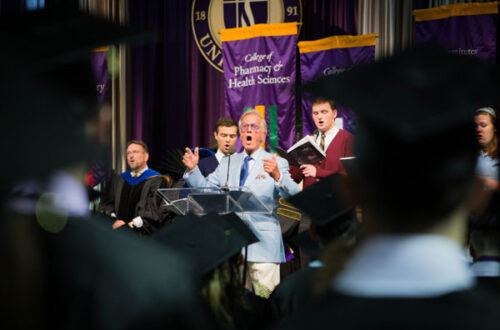
As for the Babbler, it became the Lumination Network in the 2010s. In 2022, it became Herd Media. Today, Herd Media is a digital news outlet, far removed from the Thursday nights Estes spent putting the paper to bed. Still, Estes shared advice for the current Editor-in-Chief and staff.
“You learn things not to do, and you just get smarter,” he said. “You’ll be alright.”
Feature image of Wayne Estes as Editor-in-Chief courtesy of Beaman Library Archives

Chrissy Julien
Chrissy Julien is a junior Journalism and French double major from Nashville, Tennessee.