

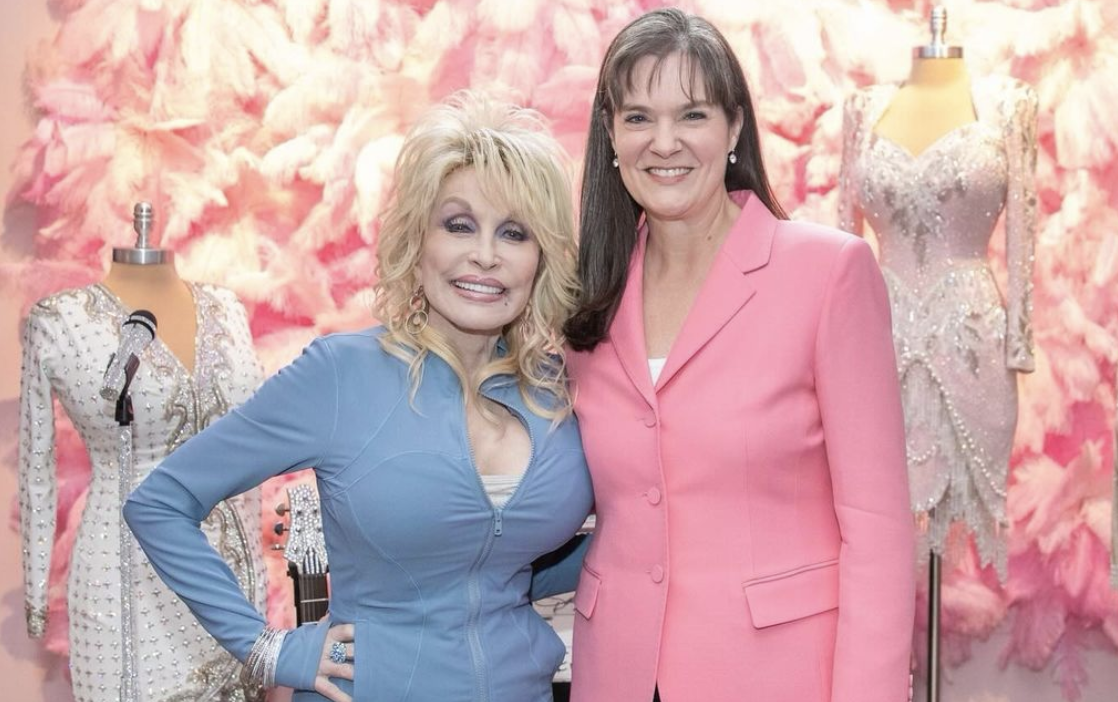
Faculty reflect on Dolly Parton’s life and legacy
This Friday, Lipscomb University celebrates “Dolly Day” as an opportunity to appreciate Dolly Parton’s legacy. The day’s date, 9/25, is a nod to Parton’s hit song “9 to 5.”
Tennessee native Dolly Parton was a country music singer-songwriter, fashion icon and philanthropist. Her passing on Aug. 26 was mourned by those who recognized her gift not only in songwriting but also in making a positive change in the world.
In the Lipscomb community, Parton’s influence can be viewed through several different lenses. Three Lipscomb faculty members shared their personal stories of how Parton inspired them.
Laurie Kubicek
Laurie Kubicek, professor in Lipscomb’s Department of Law, Justice & Society, said that she was familiar with Dolly Parton even when she lived in California, but her appreciation for Parton grew when she moved to Tennessee and visited Dollywood.
“I think the thing that I love the most [about Dollywood] is just the sort of unapologetic tip of the hat to her faith,” said Kubicek. “Everywhere you went in the park—it was everywhere. And then the Dollywood social media shares Bible verses . . . there was something so powerful about meeting a famous person of that magnitude who would then just sort of quietly use their voice for good. There’s something sort of remarkable about that.”
Kubicek also shared the powerful imagery of seeing the Dollywood exhibit for Imagination Library, Parton’s program providing free books to children from birth to age five. The experience, Kubicek said, was particularly beautiful because there was a family with a little girl in the exhibit at the same time who had gotten books from the program.
“It was the most beautiful thing. It’s so far-reaching; like, there’s a million philanthropists, and they do great things, they donate money. But I was like, that little girl? She’s holding it, and that’s the most beautiful thing.”
John J. Thompson
John J. Thompson, director of music industry studies, said that his appreciation for Dolly Parton started in 1981, when he bought a seven-inch single of Parton’s “9 to 5.”
“The song fascinated me. I couldn’t understand the genre that it fit in, and even at 11 years old, I was already starting to really obsess over music,” he said. “I was trying to figure out—is this an R&B song? It’s not a country song. What’s going on here? But I also really liked the lyrics in that it was a kind of protest song. I would say that got me to really think of her as a very serious artist.”
Thompson said that part of his admiration for Parton stemmed from her uniqueness.
“She’s that kind of classic in that you can’t find another person to compare her to. And there’s a little bit more to it than just being non-conformist. She was iconoclastic in that she could subvert something by crawling into it. So she would inhabit the character of Dolly Parton—with the wigs and the surfacy things . . . but then actually, in the ways that matter, ask the hardest questions through her art and then live out the answers throughout her life without actually filling the gap between those two things.”
According to Thompson, the best way to honor Parton’s legacy would be to continually work towards progress.
“She didn’t live in nostalgia. She pushed forward and she did stuff. . . . that’s never been popular. It’s the history of humanity. For us to put other people’s means ahead of ourselves, for us to voluntarily give up lots of our stuff—it’s never been popular, and it never will be popular. But I do think that, when God gets ahold of a person, when grace grips a person, they can be free from the power that wealth and fame and all that has.”
Charlotte Poling
Charlotte Poling, Chair of the Department of Fashion & Design, said she had been a Dolly Parton fan even before working alongside the country music star on Lipscomb’s Dolly Parton exhibition.
“I think more about her as a person than as a superstar,” Poling said. ”I think, too, us being able to interact with her, it was such a genuine conversation every single time. . . . She’s always very intentional about the things that she says and wants to make people feel good.”
Poling said that Parton’s selflessness was her most standout feature in the way she interacted with everyone around her.
“She cared about everybody. It didn’t matter what you looked like, didn’t matter how much money you had. Walking around, she doesn’t have to say hello; she doesn’t have to give a compliment; she could just, you know, walk on by. But she didn’t, ever.”
Poling said that she believes Parton’s far-reaching legacy will endure for decades more.
“She’s literally touching every industry. . . . and I think that really is not necessarily for her personal gain; I think it’s for the gain of her family. I think she’s done that to set up a legacy for other people. And I think that’s another thing about her: that’s really how she lived her life. It’s like she lived her life so that other people could be successful.”
This Friday, Lipscomb will reflect on Parton’s life and legacy, remembering not only her music but also her personal authenticity and charm.
Feature image courtesy of Kristi Jones

Noah Moran
Noah is a philosophy student at Lipscomb University, planning to attend law school after graduation and then enter corporate law. He holds an Associate of Arts in Liberal Arts from Colorado Christian University, and his interests encompass theology, philosophy, politics, and cinematography. He is involved in a variety of student organizations and serves in his local church.