

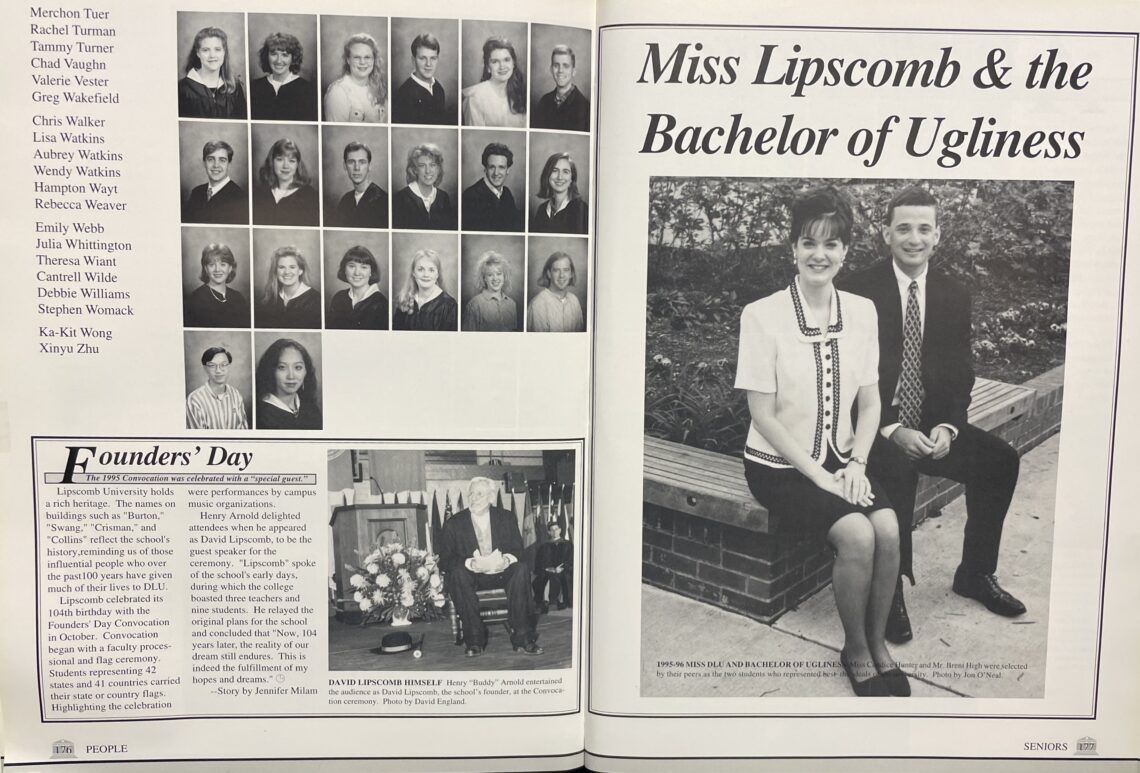
2026 and then: 30 years ago, Candice Hunter (now McQueen) was crowned Miss Lipscomb
Decades before she became president of Lipscomb University, Candice Hunter (now McQueen) earned another campus honor: being selected by her peers as the female senior who most embodies the ideals of Lipscomb.
The title, of course, is Miss Lipscomb. (The corresponding male recipient is named Bachelor of Ugliness; Brent High earned that award in 1996.)
Being nominated by faculty, staff and administrators, and then voted on by students, marked an achievement in 1996, but its meaning would take years to unfold. What felt like recognition in the moment would later reveal itself as something deeper: the early shaping of a leader whose influence would extend far beyond a single title.
“I remember how much of an honor that was because it was voted on by the student body,” McQueen said. “When your peers—your friends and colleagues—are the ones saying you represent their experience, it’s a fantastic honor.”
Unlike many accolades, Miss Lipscomb was never something students would apply for.
“I was nominated, so it wasn’t something you put forward yourself,” McQueen said. “Other people did, and that made it pretty special.”
That distinction shaped the meaning of the title. It wasn’t just recognition of achievement, but affirmation of character, of how someone lived and moved within a community.
The honor carried expectations, such as to embody Lipscomb’s values. But those expectations also created opportunity.
“It allowed me to hone my speaking skills, to be a professional representative at events,” she said. “And just having the title—it had a bit of gravitas. You got to tell your story and why Lipscomb mattered to you.”
At the time, McQueen didn’t see the experience as preparation for something larger. Like most college students, she was focused on the present: classes, organizations and opportunities to serve. For example — as depicted in an article from the 1996 Backlog — she tutored at the local Youth Hobby Shop.
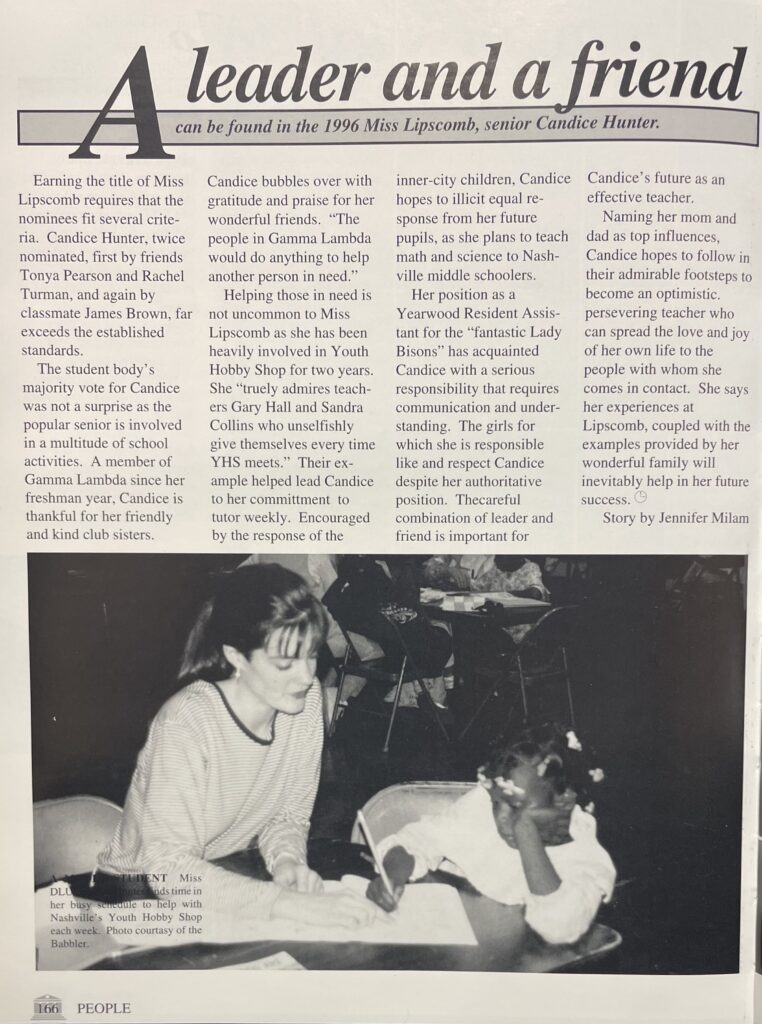
From the 1996 Backlog
But in retrospect, the patterns are clear.
Her time at Lipscomb was shaped by mentors who emphasized both humility and confidence in leadership.
“The biggest influence was the time I got to spend with phenomenal mentors, professors and leaders,” she said. “They taught humility in leadership, being a servant, but also having the confidence to make decisions, bring people together and move something forward.”
Looking back, McQueen sees a clear difference between how she understood leadership then and how she understands it now.
“When you’re younger, you think of leadership as a title,” she said. “But you realize it has nothing to do with the title.”
Instead, her definition has become rooted in service.
“Leadership is about them, not you,” she said. “If you’re not thinking about the people you serve — how to listen, how to bring them along — you won’t be a leader very long.”
That shift — from recognition to responsibility — mirrors the deeper purpose behind moments like Miss Lipscomb. What begins as affirmation becomes, over time, an invitation to grow into something more.
At the time she was elected, McQueen never imagined where her path would lead.
“The answer is really no,” she said. “As a student, I don’t think I would have ever imagined returning in a role like this.”
Her early aspirations were rooted in education, influenced by her mother, a school principal. Higher education leadership came later, shaped by opportunities and mentors who recognized her potential.
That journey — from student to president — was not defined by a single moment, but by years of preparation, growth and willingness to step into new roles.
“Whatever role you eventually get, it doesn’t just happen,” she said. “There are things that prepare you for it. And if they’re not noticed right away, the time will come.”
Throughout her journey, one constant remains: the influence of people.
From peers to professors to colleagues, McQueen describes leadership as something formed in relationships.
“I love talking to people from different backgrounds and different experiences,” she said. “I feel like every person has something to offer.”
That openness — to listening, learning and connecting — began during her college years and continues in her role today.
“Communication skills and the ability to talk to everybody — that’s something I’ve always worked on,” she said. “And it’s exactly what I get to do now.”
Today, McQueen leads the same university that once recognized her as a student leader. The campus has changed — new buildings, expanded programs, a broader reach — but some things remain constant.
Looking back, McQueen sees her Miss Lipscomb experience not as a peak, but as a starting point.
“That was the beginning of how proud I was to represent Lipscomb,” she said. “And now, years later, I get to do that in a different way.”
If she could speak to her younger self—or to students today—her message would be simple.
“Embrace the present,” she said. “Plan for the future, but don’t miss what’s right in front of you, the relationships, the people, and the opportunity to learn.”
Because moments like the one she experienced in 1996 are easy to misunderstand.
“I remember thinking that night was the highlight,” McQueen said. “But it turned out, it was just the introduction.”