
Dr. Holmes connects students through the humanities
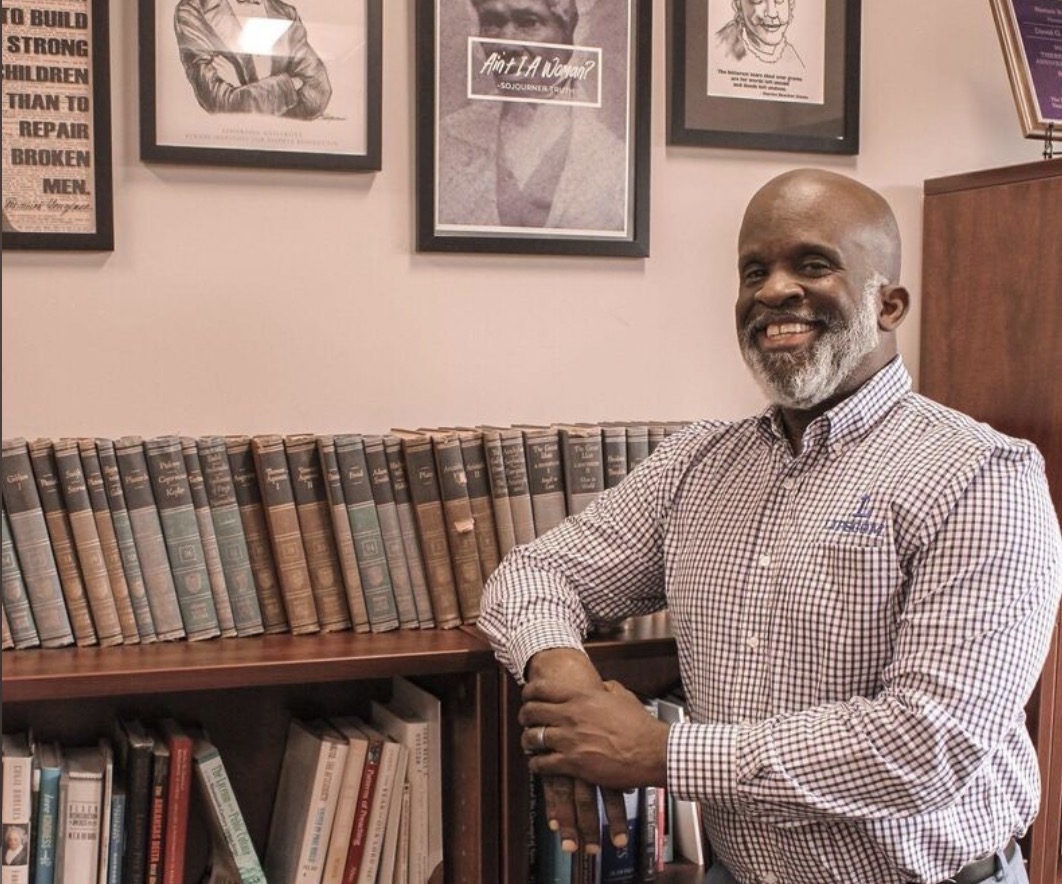
Dr. David Holmes’ passion for the humanities has moved him across the country and given him a seat at the table. At Lipscomb, he has served as the Dean of the College of Liberal Arts and Sciences and is now a distinguished professor at the university. However, for Holmes, the humanities mean more than a degree or a title.
“The humanities are about the stories we tell and the stories we hear and the stories that change us,” said Holmes. “Stories make a difference.”
Holmes’ interest in the humanities began in church. Listening to preachers was the catalyst for his life’s work. “Between that and scripture itself and church music, I fell in love with language and what language does, and what it communicates, and how it impacts people,” said Holmes.
Holmes didn’t plan on a career in higher education. “I was planning on preaching, but I was also planning on being bi-vocational and doing public school teaching,” Holmes said. Though a Los Angeles native, he attended Oklahoma Christian College and obtained a degree in speech communications.
His calling for teaching extended beyond his original plan. Holmes now holds three master’s degrees.
After returning to California, Holmes found himself at Pepperdine University. There, he rose in ranks to Associate Dean for Curriculum and Education. He became the first African American to receive tenure and the rank of full professor in the humanities department.
In 2020, he moved from California to Nashville to serve as dean for Lipscomb’s College of Liberal Arts and Sciences. He founded the Parker Society during this time, through which humanities students receive opportunities for scholarships and mentorship. In July of 2025, he stepped down as dean.
His work at Lipscomb, however, was far from over.
Holmes continues to teach at Lipscomb as a distinguished professor. In the current spring semester, he is teaching three classes, including a class on Civil-Rights-era actor Sidney Poitier. For Holmes, this is more than just a job.
“I’m enjoying teaching entirely too much,” Holmes said. “In matter of fact, I was in class this morning and I said, ‘Y’all can’t possibly be enjoying this as much as I’m enjoying sharing it.’ I just get giddy.”
His favorite part is the students. “I really enjoy what happens in the classroom, because I get to hear you guys talk. I get to hear students look at a piece of literature that I’ve been looking at for 30 years and giving me an insight I didn’t have before. And there’s nothing more magical than that.”
Holmes believes that these conversations sit at the core of a liberal arts education. “The Christian liberal arts are about spiritual and intellectual freedom,” said Holmes. “I got that idea from the current dean [of the College of Liberal Arts and Sciences], Dr. Randy Bouldin. If we’re really talking about those levels of freedom, then we’re talking about everything. We don’t abandon our convictions, we don’t cease to be Christian. But as Christian intellectuals, seeking both freedoms, we talk about everything.”
An important dialogue Holmes has on campus is that of the importance of Black studies, especially in the humanities. “Part of the humanities, because it’s about stories, helps to elevate the Black experience, because now these voices are no longer muted or devalued. They’re elevated,” said Holmes. “Our voices need to be heard.”
The humanities create space for these voices and stories. “Anytime somebody has been marginalized, the first step is to mute the voice. What they say and how they say it,” said Holmes. “There’s an unjust way to look at knowledge. And sometimes people on the margin experience an injustice to either acquiring knowledge or having their knowledge undervalued.”
Holmes doesn’t shy away from hard conversations about race. He encourages his students not to either. “Students can handle the rest of it,” said Holmes. “They can deal with stuff that is politically this and politically that if they know that at the end of it, we’re trying to connect as human beings.”
This mindset colors how Holmes approaches his students. In his classes, they talk about everything, and they do the hard intellectual work. “I’m enriched if your politics, regional experience and ethnic experience are different than mine,” said Holmes. “I’m enriched just by the encounter with you. That’s how we approach the discussion of not just African American studies, but anything.”
The human experience, whether coming from a Black perspective or any other, is at the core of the humanities.
“People fear [the humanities] because they miss the real point,” said Holmes. “The real point is to elevate what it means to be human. It’s all about the idea of being human, and being human is its own payoff.”
“If I understand what it means to be a human being,” continued Holmes, “and I understand my story, that will give me more empathy for your story.”
Holmes’ approach to humanities puts on full display why the field is important, beyond degrees and important positions. Through it, Holmes honors his history while empowering his students.
“The beginning of our discussion and the end of our discussion is this: we are all human.”

Chrissy Julien
Chrissy Julien is a junior Journalism and French double major from Nashville, Tennessee.